

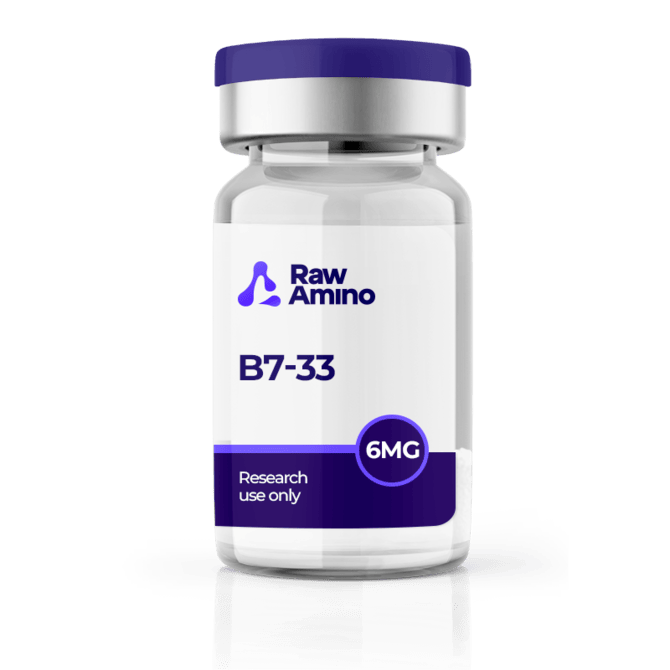
B7-33 – 6MG
$64.00
Scientific Overview of B7-33
B7-33 is a synthetic peptide derived from the larger protein H2-relaxin (Relaxin). This peptide has been examined for its possible role in signaling pathways that may relate to fibrosis, tissue remodeling, and vascular processes. Research suggests that B7-33 may influence extracellular matrix regulation and interact with Relaxin-related receptors.
Alternative Names: (B7-33)H2, GTPL9321
B7-33 Studies and Research Data
B7-33 Investigations into Fibrosis and Tissue Remodeling
Scientific studies have suggested that the peptide may act as a selective agonist for RXFP1 receptors, appearing to favor the pERK1/2 pathway rather than the cAMP pathway. This preference has been associated with potential collagen regulation, possibly through stimulation of metalloproteinase enzymes such as MMP-2. Animal model research has explored B7-33 in scenarios of cardiac damage and chronic allergic conditions, where it was proposed to play a role in limiting fibrosis and remodeling.
Vascular Function and Endothelial Response
Explorations into vascular biology indicate that B7-33, alongside H2-relaxin, may support endothelial responses. In murine models, it was observed to possibly enhance bradykinin-mediated relaxation in certain arteries, likely through mechanisms involving endothelium-derived hyperpolarization. Some research has also suggested that it could reduce markers of endothelial dysfunction in experimental systems.
B7-33 Research on Preeclampsia
Studies of pregnancy-related complications have considered the role of B7-33 in placental biology. It has been suggested that the peptide and its lipidated derivative may influence cytotrophoblast activity, potentially modulating angiogenic factors such as VEGF. Experimental findings propose that this modulation could contribute to maintaining balance in vascular growth signals under stress conditions like hyperglycemia or exposure to certain compounds.
Materials Science and Biomedical Applications
B7-33 has also been investigated in biomaterials research. Coatings releasing this peptide were reported in laboratory studies to potentially reduce fibrotic capsule thickness around implanted devices. Such findings have raised interest in whether B7-33 could be applied to materials intended to mitigate fibrosis associated with foreign body response.
Comparative Simplicity in Production
Compared to the full H2-relaxin protein, B7-33 is structurally simpler and may be more economical to produce. This relative simplicity has encouraged further interest in studying the peptide as a research tool for receptor-specific interactions.
Be the first to review “B7-33 – 6MG”
You must be logged in to post a review.
Related products
Peptides
Peptides
Peptides
Peptides
Peptides
Peptides
Peptides
Peptides
Reviews
There are no reviews yet.