

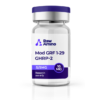

Mod GRF 1-29 & GHRP-6 – 10MG
$83.00
Scientific Overview of Mod GRF (1-29) & GHRP-6 Peptide Blend
Modified Growth Hormone Releasing Factor (Mod GRF 1-29) and Growth Hormone Releasing Peptide-6 (GHRP-6) are laboratory-designed peptides that researchers suggest may contribute to the stimulation of growth hormone release in experimental contexts. Though they appear to share a related outcome, the two peptides are believed to act through distinct pathways. Mod GRF (1-29) originates from a fragment of Growth Hormone Releasing Hormone (GHRH), while GHRP-6 is a synthetic hexapeptide structurally related to endogenous peptides like met-enkephalins. Their different receptor interactions have led researchers to speculate that when studied together, they may demonstrate complementary or synergistic actions in cellular systems.
Alternative Names: Modified Growth Hormone Releasing Factor (1-29), GHRP-6 (Growth Hormone Releasing Peptide-6)
Mod GRF (1-29) & GHRP-6 Studies and Research Data
Cellular Signaling Pathways and Pituitary Activity
Research indicates that Mod GRF (1-29) may bind to growth hormone-releasing hormone receptors located on somatotroph cells of the anterior pituitary. This interaction appears to trigger signaling events involving adenylyl cyclase, cAMP, and protein kinase A, which may contribute to changes in calcium channel behavior and stimulate the release of growth hormone. Some studies report a measurable increase in growth hormone release and corresponding insulin-like growth factor-1 (IGF-1) production in response to Mod GRF (1-29).
Conversely, GHRP-6 is thought to act through the ghrelin receptor, also known as the growth hormone secretagogue receptor (GHS-R1a). Its interaction may activate phospholipase C pathways and secondary messengers such as IP3 and DAG, potentially facilitating intracellular calcium release and subsequent secretory responses. In experimental settings, this pathway has been associated with a substantially elevated growth hormone release when compared to control conditions.
Mod GRF (1-29) & GHRP-6 Investigations on Brain and Neural Function
GHRP-6 has been explored in relation to cognitive and neurological contexts. Rodent studies suggest it may support learning, memory, and recovery following ischemic events. Findings include reduced infarct size, possible protection against glutamate-induced cell damage, and induction of neuroprotective mediators such as IGF-1 in brain regions including the hippocampus and cerebellum. While Mod GRF (1-29) has been less directly studied in this regard, its contribution as part of a blend has been hypothesized to complement the pathways stimulated by GHRP-6.
Mod GRF (1-29) & GHRP-6 Interactions with Immune and Inflammatory Pathways
Beyond its primary signaling, GHRP-6 appears to interact with CD36 receptors, which are linked to lipid metabolism, macrophage function, and angiogenesis. Some experimental findings suggest that GHRP-6 may compete with oxidized lipoproteins for receptor binding, which could alter foam cell development in atherosclerosis models. Research also highlights its potential to reduce oxidative stress markers in cardiac tissue, suggesting broader relevance in cellular stress studies. The impact of combining Mod GRF (1-29) with these properties has not yet been clarified.
Muscular and Skeletal Research Themes
Laboratory work has considered whether the blend of Mod GRF (1-29) and GHRP-6 may contribute to increases in lean tissue mass and bone density through IGF-1 signaling. Findings from individual peptides suggest rises in IGF-1 may correspond with changes in muscle growth markers. When studied together, some reports describe amplified pulsatile growth hormone release, possibly indicating a synergistic interaction. Separate research in rodent models has pointed to increases in bone mineral density associated with growth hormone secretagogues like GHRP-6, with potential implications for bone cell development and mineralization.
Conclusion
Overall, Mod GRF (1-29) and GHRP-6 have been studied as distinct peptides with complementary pathways that may converge on growth hormone and IGF-1 signaling. Evidence from cellular, animal, and biochemical studies suggests possible contributions to pituitary signaling, neurological processes, immune modulation, muscular development, and skeletal research. The combined exploration of these peptides remains of scientific interest, though findings are preliminary and context-dependent.
Be the first to review “Mod GRF 1-29 & GHRP-6 – 10MG”
You must be logged in to post a review.
Related products
Peptides
Peptides
Peptides
Peptides
Peptides
Peptides
Peptides
Peptides
Reviews
There are no reviews yet.