

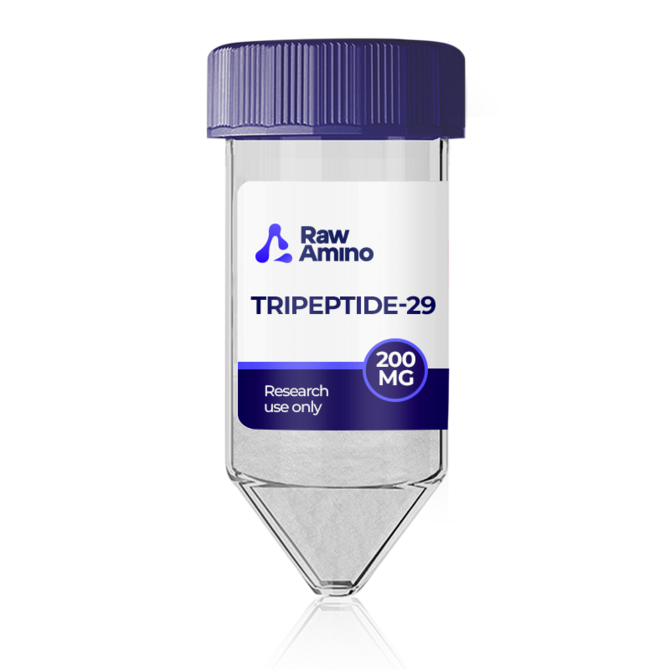
Tripeptide-29 – 200MG
$184.00
Scientific Overview of Tripeptide-29
Tripeptide-29 is a synthetic tripeptide modeled on repeating collagen motifs. Collagen is composed of short amino acid sequences that assemble into complex structures, which may contribute to structural resilience in various tissues such as bone, tendons, and the dermal barrier. Tripeptide-29 reflects one of the common repeating units found in collagen, and has been investigated in experimental studies for its potential influence on processes such as matrix stability, oxidative regulation, coagulation activity, and tissue remodeling.
Alternative Names: Gly-Pro-Hyp peptide, Collagen-derived tripeptide
Tripeptide-29 Studies and Research Data
Investigations into Fibrosis and Enzyme Modulation
Laboratory models suggest that Tripeptide-29 may interact with dipeptidyl peptidase IV (DPP4), an enzyme associated with the breakdown of bioactive peptides and processes linked to fibrosis. Research indicates that inhibition of this enzyme could reduce excessive connective tissue buildup in experimental systems. Findings point to Tripeptide-29 as a potential contributor in studies exploring scarring and fibrotic progression.
Tripeptide-29 Structural Contributions to Collagen Stability
Research on short peptide fragments proposes that the hydroxyproline residue present in Tripeptide-29 may help strengthen collagen fibrils. Observations suggest that this structural component appears to promote favorable molecular interactions, reduce degradation under UV exposure, and possibly enhance the resilience of collagen. Such findings contribute to understanding how minor sequence changes may impact macromolecular stability.
Tripeptide-29 Explorations in Coagulation Pathways
Experimental platelet models indicate that Tripeptide-29 may act as a partial agonist of the collagen receptor GPVI. This interaction appears to stimulate phosphorylation signaling cascades that are commonly observed in platelet activation. Such responses may be valuable in better understanding mechanisms of clot initiation and vascular repair in controlled research conditions.
Oxidative Stress and Aging Mechanisms
Several studies suggest that Tripeptide-29 may act as a scavenger of reactive oxygen species, potentially lowering oxidative stress. Researchers have also proposed that it may influence the accumulation of advanced glycation end products (AGEs), compounds considered to accelerate tissue aging. Findings suggest that by influencing these processes, Tripeptide-29 may help illuminate cellular pathways relevant to dermal aging and structural decline.
Tripeptide-29 Experimental Research on Dermal Models
Pilot investigations exploring tripeptides, including Tripeptide-29, have reported observations linked to hydration, elasticity, and contour in skin models. Experimental reports suggest reduced irregular pigmentation and improved dermal uniformity, with some studies noting enhanced flexibility and moisture compared to baseline conditions. These outcomes highlight the continued research interest in tripeptides for dermal investigations.
Conclusion
Tripeptide-29 has been studied in multiple laboratory contexts, ranging from collagen structure and oxidative processes to platelet activity and fibrosis pathways. Research findings suggest that this tripeptide may contribute to broader understanding of how short peptide motifs influence stability, signaling, and cellular responses. Continued investigations may clarify its role as a model compound in collagen-related and dermal-focused research.
Be the first to review “Tripeptide-29 – 200MG”
You must be logged in to post a review.
Related products
Peptides
Peptides
Peptides
Peptides
Peptides
Peptides
Peptides
Peptides
Reviews
There are no reviews yet.